Limited Seats
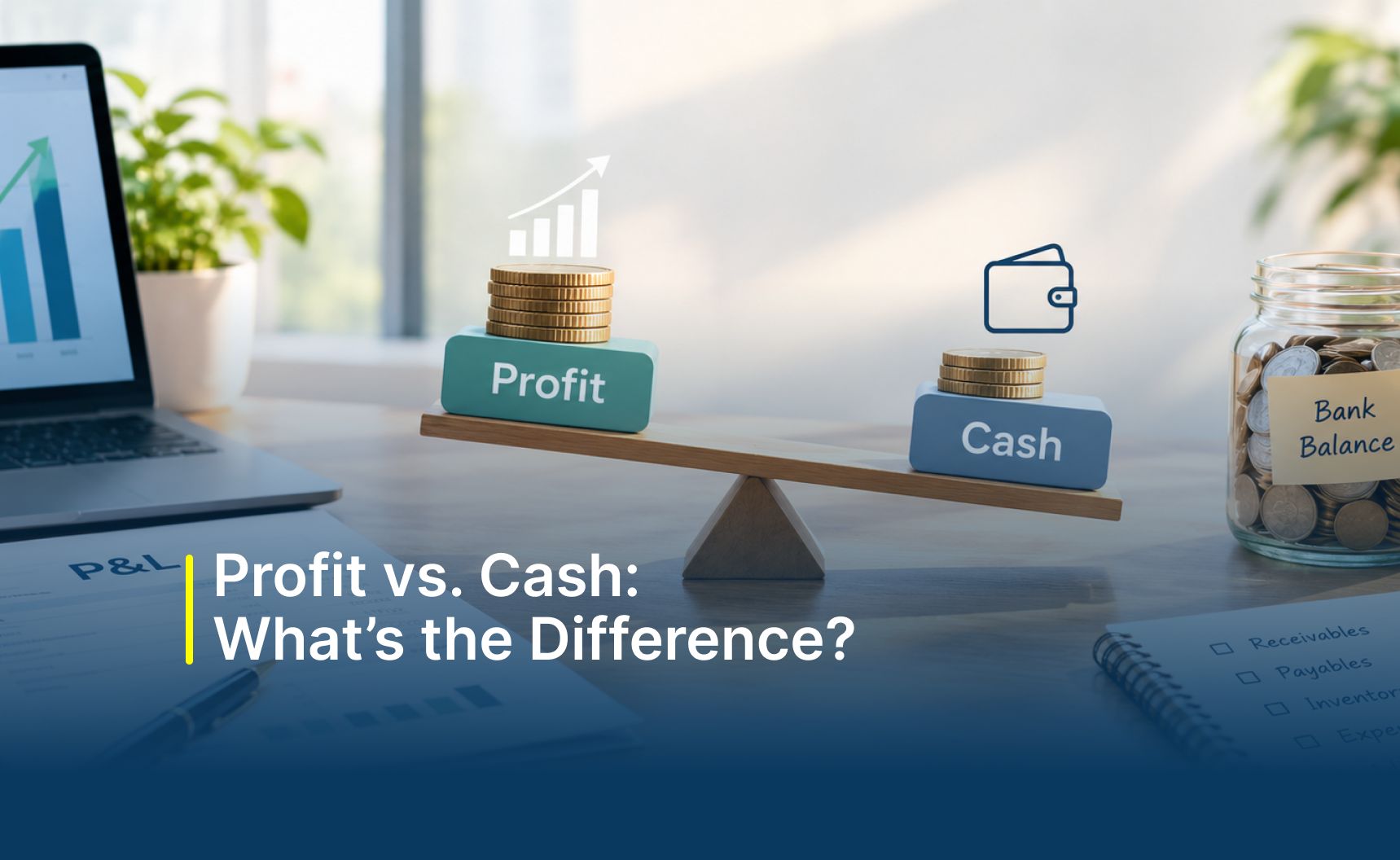
Your profit and loss statement indicates a profit of ₹8 lakhs for the last month. But your bank account balance shows only ₹1.5 lakhs. Which number could be wrong?
Neither of them!
It is a common dilemma for many business owners. The business is doing well on the profit side while the amount in the bank seems considerably low. This does not imply anything bad. It is quite natural because different factors influence each figure.
Here, you will understand why this difference exists and how it will be helpful to take proper decisions when it comes to expenditure and other business activities.
Profit and cash reveal different things about your company.
While profit shows how much the company has made and spent over a period, based on recorded income and expenditure,Cash flow shows how cash is actually generated and used by the business during a period, including cash from operations, investments and financing activities.
In other words, a company can be profitable without having much cash in hand because customers may not have paid yet, or the company may have invested in stocks or made loan repayments.
For profit vs cash flow for small business, the gap usually comes from a few common areas. Here are five situations where your P&L and bank balance can tell very different stories.
1. Receivables: You Made the Sale, But Haven’t Collected the Money
When you sell on credit, the income can be recorded in your accounts even though the customer hasn't paid yet. So your profit can go up while your bank balance stays the same.
Example:
You raise an invoice for ₹5 lakhs in March with 60-day payment terms. The sale may be reflected in your March accounts, but the ₹5 lakhs may only reach your bank account in May.
2. Payables: The Expense Is Recorded, But Payment Is Still Due
The opposite can happen with your expenses. A vendor bill may be recorded when you receive the goods or service, while you may have another 30 or 45 days to make the payment.
Example:
You receive ₹3 lakhs worth of goods in March and agree to pay the vendor after 45 days. The expense may be reflected in your books in March, but the cash leaves your bank only in May.
3. Inventory: Cash Goes Out Before the Stock Is Sold
Buying stock can use up a large amount of cash, but the full amount doesn't necessarily become an expense immediately. Inventory purchases use cash immediately, but they generally become an expense in the P&L when the inventory is sold.
Example:
You spend ₹10 lakhs on raw materials in March. The ₹10 lakhs leaves your bank account immediately, but if some of that material is still in stock at month-end, its full cost won't be reflected as an expense in that month's P&L.
4. Capital Expenditure and Depreciation
Buying equipment can create a large cash outflow, while the P&L records the cost over time through depreciation, subject to the applicable accounting rules.
Example:
You buy machinery for ₹12 lakhs. Your bank balance falls by ₹12 lakhs when you pay for it, but the P&L doesn't usually show the entire ₹12 lakhs as an expense at once. Instead, depreciation is recorded over its useful life.
5. Loan Repayments, GST and Taxes
Loan EMIs affect your cash every month, but only the interest portion is generally an expense in the P&L. The principal repayment reduces the loan balance. GST and tax payments can also create a cash outflow even though they don't work like a normal business expense.
Example:
If your monthly EMI is ₹1 lakh and ₹70,000 is principal while ₹30,000 is interest, the full ₹1 lakh leaves your bank account. But only the ₹30,000 interest is generally reflected as an expense in the P&L.
Likewise, GST collected from customers is generally not business revenue. But when GST is paid to the government, the payment still affects the cash available in your bank account.
If your P&L shows a profit but the bank balance doesn't look the same, start with the profit and trace what happened to the money.
For example; Take your net profit as the starting point. Then add back non-cash expenses such as depreciation. Next, account for money tied up in receivables and inventory, and add amounts you haven't paid to suppliers yet. From there, consider money spent on equipment and loan principal repayments.
What you get is a much clearer picture of how much cash the business actually generated or used during the period.
You don't need a complicated system for this. A simple one-page monthly tracker can include:
Net profit
Receivables
Inventory
Payables
Major purchases
Loan repayments
Bank balance
Looking at these numbers together can help you understand why a profitable month may still leave you with less cash than expected.
A growing business can actually face more pressure on cash.
When sales increase, customers may owe you more money. You may need to keep more stock. You may hire more people, buy equipment or spend more before those new sales are collected.
For example, if your sales grow from ₹50 lakhs to ₹1 crore, but customers take 60–90 days to pay, a bigger portion of your money can remain stuck in receivables.
This is how a business can become profitable but cash-poor. The business is growing, the P&L looks good, but there isn't enough cash available when payments are due.
That's why cash flow management for small businesses needs to be planned before the business scales, not after a cash shortage becomes a problem.
You don't need a complicated financial system to keep track of your cash. A few regular checks can give you a much better picture of where the business stands.
Check receivables every month. Know how much is pending for 30, 60, 90+ days.
Review profit and cash separately. Your P&L review and cash review should answer different questions.
Keep a 13-week cash forecast. Before hiring or making a large purchase, check whether the cash will be available when you need it.
Track GST separately. GST collected from customers should not be treated as money available for regular business expenses.
Look at payment terms, not just price. A customer taking 90 days to pay can affect your cash more than a small difference in the selling price.
Your profit tells you how the business is performing. Your cash tells you how much money you actually have available.
Neither number tells the whole story on its own.
The important part is understanding why they are different and what that difference means for the business. Once you start looking at receivables, inventory, payables, loans and upcoming payments along with your P&L, you can make decisions with a clearer picture of what is happening.
This is one of the things business owners learn in the Fintax Business 5-Day Masterclass. The focus is not just on looking at financial statements, but on understanding your own numbers and using them when making business decisions.
If you want to become more confident in reading your business numbers and making decisions based on cash, profit and financial performance, explore the Fintax Business 5-Day Masterclass or speak to our team.
FAQ
Why does my P&L show profit but my bank balance is low?
Your sales may be recorded, but the money may not have been collected yet. Cash may also be tied up in stock, equipment or loan payments.
What's the difference between profit and cash flow?
Profit shows what the business earned after expenses. Cash flow shows the money actually coming in and going out.
How do I forecast cash flow?
List your expected weekly collections and payments, including salaries, vendors, GST, EMIs and other major expenses.
Does GST collected count as revenue?
Generally, no. GST collected from customers is paid to the government and isn't business revenue.
Why does the profit-cash gap grow as a business grows?
More sales can mean more money tied up in receivables and stock. Expenses and investments may also increase before the cash comes in.
More insights to grow your business finance skills.

Let's start with a real example of the importance of financial literacy for business owners.

Revenue may look good on paper, but that doesn't mean your business is financially healthy. Revenue and profit alone d...

Capital required for a dental clinic can be around ₹30 to ₹50 lakhs. Whether the funds are sourced through personal sa...
