Limited Seats

The majority of business owners consider their balance sheet as something that they need to give to their CA or financial analyst to see if everything is okay and sign it. Later on, it may become something that the CA will take care of once a year and the owner will not even look at his balance sheet.
In fact, your balance sheet is something that you need to know since it shows you the value of your business, its structure, and what is left after everything is counted. Your balance sheet shows you the financial state of your business at the moment.
If you do not know how to read your balance sheet, we can help you interpret the numbers and parameters on it.
Keep reading to understand how to read a balance sheet.
The entire balance sheet is based on a single fundamental formula.
Assets = Liabilities + Equity
Simply put,
Things owned by the company = Things owed to other entities + Things owned by the owner
Every entry in the balance sheet comes under one of the above categories. The assets represent the things owned, the liabilities represent the things owed to other entities, and the equity represents the value left to be owned by the owner after everything else is taken into account. Combining everything together, it helps you read a balance sheet for a small business.
Example:
If a company has total assets of ₹1 crore and liabilities of ₹60 lakh, the leftover ₹40 lakh will represent equity.
₹1 crore = ₹60 lakh + ₹40 lakh
Thus, while the company has ₹1 crore worth of assets, the value that belongs to the owner in the balance sheet is ₹40 lakh.
A balance sheet is all about your assets, liabilities and equity. Getting a good understanding of these three will give you an idea about your financial standing.
1. Assets – What the Business Owns & Controls
Assets are the things owned or controlled by the business that have some value.
Current assets: These are the assets that are expected to be converted into cash, sold, or used up within the next 12 months, such as cash, receivables and inventory.
Fixed assets: These are the long-term assets like property, equipment and vehicles.
Not all assets are always useful. For instance, an uncollected receivable from the customer is an asset; however, if the customer fails to pay the amount, it might finally turn into a loss for the business.
2. Liabilities - What the Business Owes
Liabilities are the amounts that are required to be paid by the business to others.
Current Liabilities: Amounts that are payable within a short period of time, e.g., payable to vendors, short-term borrowings, GST/TDS payable, and the current portion of EMI.
Long-term liabilities: Amounts that are payable over a longer period, e.g., term loans, long-term business loans, etc.
Liabilities are not necessarily bad. It helps the business to grow through borrowing. What is important is the ability of the business to repay with the cash flow that it expects.
3. Equity - What belongs to the Owners
Equity is the amount left to the owners when the liabilities are deducted from the assets of the business.
It includes Owner’s Capital/Share Capital and Retained Earnings.
Retained earnings are the amounts of the profit that are left in the business rather than distributed to the owners.
It is where the connection between the Balance Sheet and the P&L lies. The profit in the P&L helps create the retained earnings in the Balance Sheet.
In simple terms: Equity = Assets – Liabilities
A P&L statement never reveals these three important metrics, but a balance sheet does. Here is what you must understand from solvency, leverage, and real net over time.
The solvency of a business is all about having enough resources to be able to meet its financial commitments, especially when growth has slowed or cash flows have declined.
The most basic ratio used in assessing this is the current ratio, which divides current assets by current liabilities.
In simple terms:
How many rupees worth of current assets do you have for every ₹1 of liability that needs to be paid in the coming 12 months?
For instance, if your business has ₹50 lakh of current assets and ₹25 lakh of current liabilities, then the current ratio would be 2.
₹50 lakh ÷ ₹25 lakh = 2
This means that you have ₹2 of current assets for every ₹1 of short-term liabilities.
While a good ratio may give you some room for breathing, the figure itself is not the whole story. You will have to consider what the current assets consist of. ₹20 lakh of cash is entirely different from ₹20 lakh of receivables that have not been received from customers.
2. Leverage — How Much of the Business Is Funded by Debt?
Leverage indicates the proportion of money that has been invested in your business through borrowing against the funds of owners or shareholders.
Debt financing will assist the company to increase its growth rate. However, with an increase in the amount of debt, the interest and repayments also increase, while limiting growth
For instance, let’s assume there are two companies which have identical total assets of ₹5 crore each, but these companies are in totally different scenarios in terms of finances as follows:
Company A – ₹1 crore debt and ₹4 crore equity.
Company B – ₹4 crore debt and ₹1 crore equity.
While both companies have identical asset bases, Company B has a much higher leverage position.
This is crucial before borrowing any money from outside the organisation.
Revenue growth is essential, but it does not necessarily mean that the company is getting better financially.
Your equity provides another perspective on how much is actually left for the owners once the liabilities of the business are taken into account.
Monitoring the equity of the business from year to year may tell you if the business is gaining or losing value.
For example:
Year 1: Equity – ₹2 crore
Year 2: Equity – ₹2.5 crore
Year 3: Equity – ₹3.2 crore
When both revenue and equity are growing, it may indicate sustainable growth.
But revenue may grow even when equity is declining. It may be due to continuous losses, excessive debt, huge draws by the owners or other reasons that result in reducing the equity of the owners.
This is why the founders should not consider only revenue growth. Revenue shows how much the business earns, whereas equity shows what is actually being built for the owners.
Even without being an expert in finance, there are many things that one can learn from their balance sheet. There are several simple tests which one should consider in order to detect any problems before it is too late.
When you want to calculate the current ratio for a small business, here is what you should do first:
Current Assets ÷ Current Liabilities
Any ratio which is below 1 indicates that current assets of the business are less than its current liabilities. It might be an alarm signal because it suggests that the firm does not have enough assets for its short-term obligations.
However, the ratio alone is not the only thing which should be considered. One should analyse the composition of current assets as well. The ratio might appear to be fine due to high receivables balance.
Examine receivables relative to total assets and consider changes over multiple periods.
If receivables are growing but cash inflows are lagging behind, then collection problems may be the reason for this growth rather than growth of the business.
If, for instance, sales are rising but a growing proportion of cash continues to stay with customers, this means that the business is growing in theory, but not in terms of cash.
Consider the amount of cash withdrawn from the business relative to earnings retained in the business.
The profit-making business may have a lot of cash withdrawn by its owners, which reduces the cash available in the business.
The question to ask is: Are you taking out more than the business is actually retaining?
Compare this year's equity with last year's. Evaluate whether it's growing, shrinking or maintaining flat?
If the P&L shows good revenue and profits but equity is not increasing, it is worth understanding why. Losses from other periods, owner drawings, debt and other factors can affect the equity position.
Looking at equity over time gives you a better view of whether the business is actually building value for its owners, rather than just growing its revenue.
Your balance sheet can give you a good indication of the financial state of your business, provided you understand more than just the numbers at the top. Here are some of the most common ways in which founders tend to misinterpret their balance sheets:
1. Taking Total Assets to be the Value of the Business
₹5 crore total assets does not equal ₹5 crore business value.
You have to factor in liabilities too. So, if the assets are backed by ₹3 crore in liabilities, then the equity would be ₹2 crore.
Assets – Liabilities = Equity
Gives you the book value of what belongs to the owners. What the business is actually worth to a buyer or investor is a separate question, and that’s what a valuation answers.
2. Assuming that a High Cash Balance Equals a Healthy Business
Having a high cash balance is certainly reassuring, but it must be considered along with future obligations.
For example, if your business has ₹1 crore in cash but ₹1.5 crore liabilities coming up soon, then the cash balance won’t seem as comforting as it did at first.
Cash must always be considered along with payables, loans, taxes, etc.
3. Overlooking Increasing Receivables
Accounts receivable may be present on the balance sheet as assets but not be considered cash in the bank.
The increase in receivables might imply that the customers are delaying their payments. In such a case, the company records revenues and profits while holding onto cash.
4. Overlooking Increasing Inventory
While inventory is considered an asset too, it will turn into cash only once it is sold and collected.
An increasing inventory with no growth in sales may indicate that money is invested into products that are difficult to sell or are not expected to be sold at all.
5. Looking at Income Statement Metrics without Checking Equity
A company can show rising revenues and even profits, while the equity of its owner does not grow.
Drawings from the owner’s account, accumulated losses, debts, and other factors may influence the equity. Thus, focusing on the P&L statement may give you a wrong idea about the performance of your business.
6. Considering the Balance Sheet Report as an Annual Report
Founders tend to pay attention to the balance sheet report only when it is prepared by the CA along with annual financial statements.
However, this approach may allow problems to appear and accumulate unnoticed for months.
The regular review of the key balance sheet metrics, such as cash, receivables, inventory, liabilities, and equity, may help you detect any changes.
The balance sheet is not just another financial report compiled at the year-end. It may help you see what your company owns, what it owes, what is left for the owners, and whether the company creates any value.
It all comes down to knowing what to look for and understanding what those numbers say. Getting a detailed understanding of the balance sheet can help gain clarity on what the business should focus on to maintain sustainable growth. Following a checklist as mentioned above can help you gain a clear understanding on where your business is going.
If you are having trouble understanding your balance sheet and using the figures to make business decisions, the Fintaxbusiness 5-Day Masterclass can teach you how to do it.
What is the basic balance sheet equation?
Assets = Liabilities + Equity is the basic equation.
How do I know if my business is financially healthy from the balance sheet?
Check your cash, receivables, liabilities, debt and equity to see whether the business can meet its obligations and build value.
What is a good current ratio for a small business?
A ratio above 1 generally means current assets exceed current liabilities, but the right level depends on the business.
What's the difference between retained earnings and profit?
Profit is earned during a period. Retained earnings are profits kept in the business over time.
How often should a business owner review their balance sheet?
At least quarterly, rather than waiting for the annual financial statements.
More insights to grow your business finance skills.
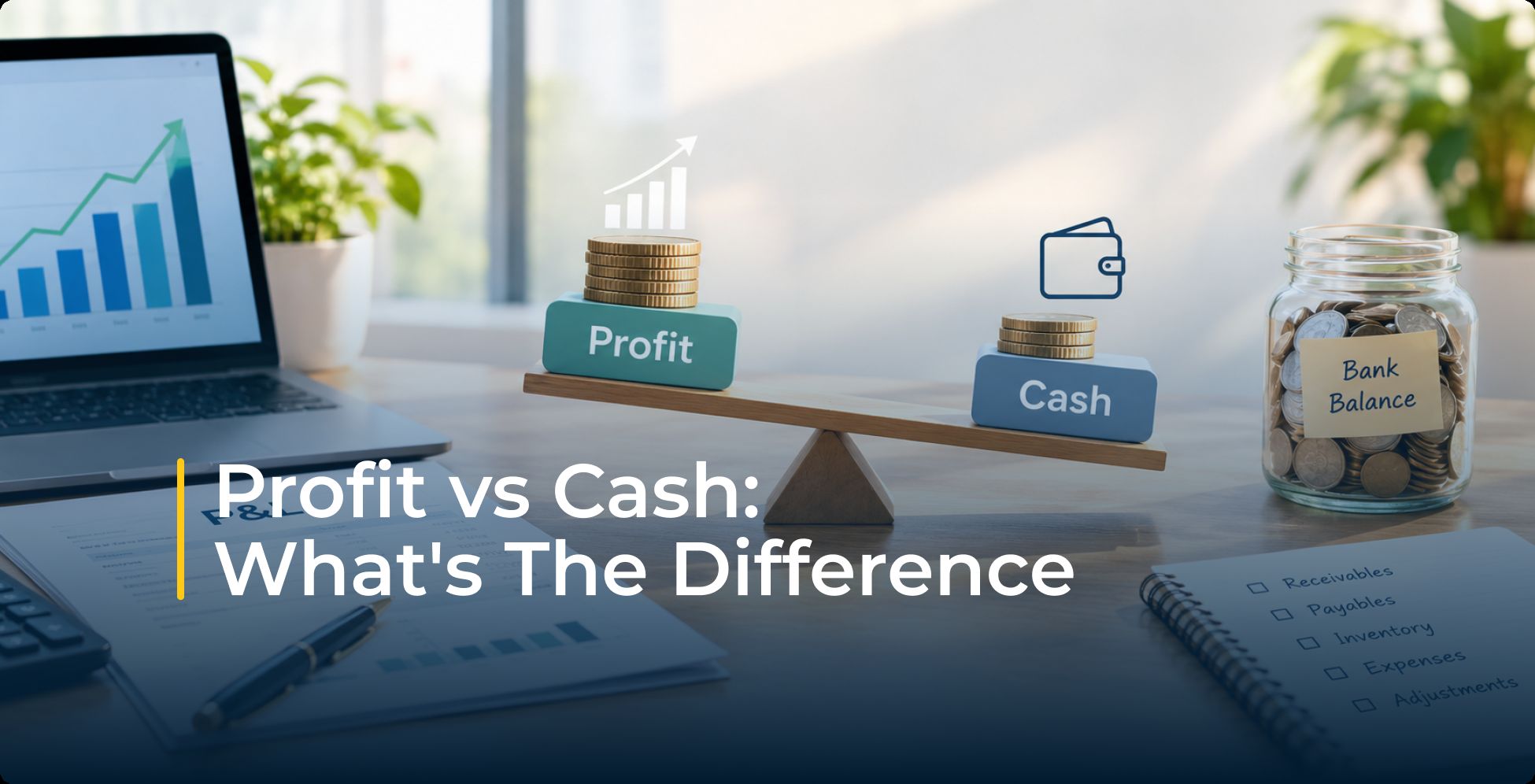
Your profit and loss statement indicates a profit of ₹8 lakhs for the last month. But your bank account balance shows ...
Let's start with a real example of the importance of financial literacy for business owners.

Revenue may look good on paper, but that doesn't mean your business is financially healthy. Revenue and profit alone d...
