Limited Seats
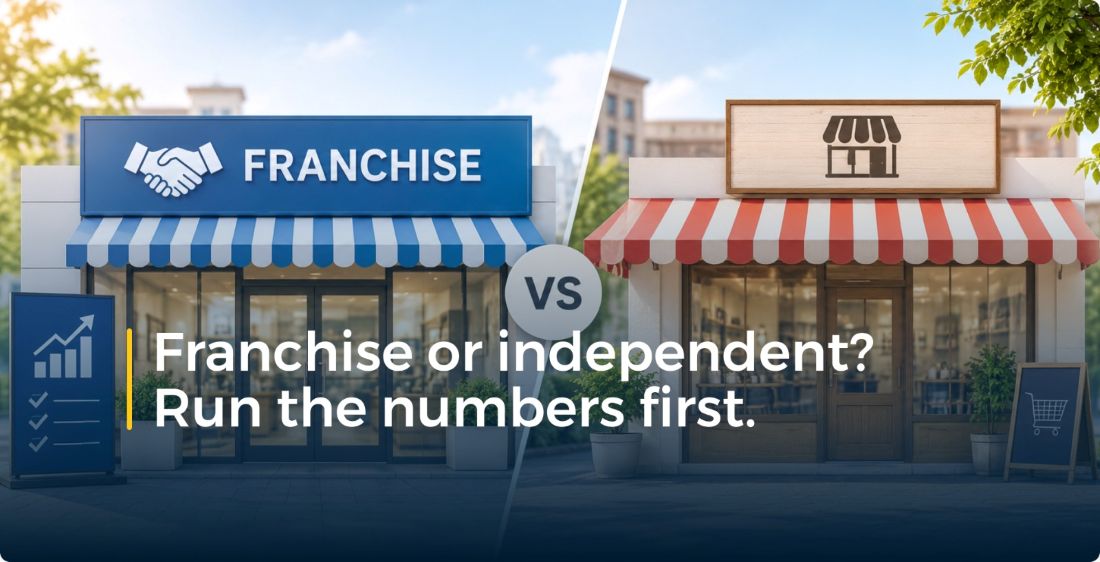
Launching a business is a significant financial step, especially if this is your first venture into entrepreneurship. The most crucial question here is whether you will launch a business as an established franchise or as an independent business.
With a franchise, you can rely on the existing brand, business model, and operational system. If you decide to create an independent business, you will get more freedom to develop your brand, make your decisions and manage your business.
However, each of these variants has its own pros and cons, and also involves various costs, financial risks and business growth potential.
This decision should not be made based solely on the attractiveness of the franchise or independent business idea.
It is important to understand how much money you will invest, how much time you will spend on the return on investment, what your monthly expenses will be and how much control over the business you will have.
Here is what the financial difference between these two businesses looks like.
People usually start by comparing the initial investment between a franchise and an independent business. However, there are many other factors that constitute the actual cost of doing business apart from the startup cost.
Understanding the complete franchise cost breakdown is important because some expenses continue throughout the business relationship.
Franchise costs:
The money you pay to buy a franchise gives you the rights to an established brand and business model. The investment normally covers:
Initial franchise fee: Initial investment of a fee to secure the brand partnership, the business model and the support system in place. This fee may not be refundable.
Royalties: Continuous payment of some amount to the owner of the franchise. This is normally a percentage of sales or profits.
Marketing: A franchise could make you pay some other fee towards their brand marketing.
Interior design, machinery and equipment: There may be a set standard for what your interior design and machinery should look like to be allowed to own the franchise.
Renewal fee: Some contracts include the renewal cost for extension after expiry of the contract.
Apart from these expenses, you should also account for rent, employee salaries, inventory, utilities and working capital.
Independent setup costs:
When you start a business on your own, you don’t have to worry about paying any franchise fees or royalty payments. You have to create certain things on your own.
The other investment capital may include:
Brand creation: Creating a brand for yourself, a logo and the positioning of your business.
Marketing and advertising: Marketing and advertising on your own because you don’t have the brand name that will help you get customers.
Business systems: Creating your own system of accounting, inventory management, sales, customer service, and operations.
Infrastructure: Creating the infrastructure of the office and buying the equipment needed for operations.
Professional assistance: Getting professional assistance for creating certain financial, operational and management systems.
Once you have understood the concept of initial investment, the next step is very straightforward: How long will it take for your business to become profitable?
It is here that the importance of break-even analysis comes into play.
The break-even point is the point when the total amount of revenue is equal to the total cost of the business. It means that at the break-even point, there is no profit or loss made by the business.
Break-Even in a Franchise Business
A good thing about the franchising system is that it could already have a history of running the business.
The franchisor could be able to provide you with the performance reports from the running business, such as the expected monthly revenues, costs of operation, profitability, and the time taken to break even.
Such performance reports can help you get an idea of how your outlet will perform.
But remember that just because one business is performing well does not mean that your business will operate in the same manner, since many factors influence its performance.
So, don't trust the promised break-even time without looking at the real figures behind it.
Break-Even in an Independent Business
In the case of an independent business, you have to determine how much time is needed to achieve the break-even point.
As there is no network of business already existing, the estimates will depend on market research, sales expectations, operating expenses, and customer acquisition.
Therefore, the significance of financial planning becomes even greater.
When comparing a franchise and independent business in India, the comparison of realistic financial projections instead of sales promises may help avoid mistakes.
Profit does not equal cash flow. A business can make a profit on paper but may be having trouble paying salaries, rents, suppliers and other bills.
The manner in which money flows into and out of your business will depend greatly on the business model that you choose.
Cash flow in a Franchise
Franchise offers a better structure and more predictable cash flow for conducting business activities. You have a set price structure, sources of supply, operational procedures, and sometimes even a customer base.
All these can make financial forecasting easier, assuming that the brand is in demand in your selected area.
On the other hand, there are constant financial obligations. Royalty payments, marketing fees, and other payments can lower the cash flow available for business activities.
Cash flow in an Independent Business
Having an independent business provides you with more flexibility in handling costs, pricing, and business management.
This is because you have the freedom to lower the cost of marketing in a tough month, change suppliers or add new products based on customer demand.
But sales will take time to stabilise since you will be developing both the customers and the brand name from scratch.
You need to be ready for unforeseen costs and low revenues as well.
What does this mean for your business?
Think about your financial requirements over the next 12 to 24 months. Will you have enough working capital to manage expenses, hire employees and expand operations?
Your decision should consider not only the expected profit but also whether your business can maintain sufficient cash flow during difficult periods.
While many new entrepreneurs think about how to establish their venture, they do not think about another critical aspect: What happens if you want to sell or exit your business?
Here is where the two business models can create quite a difference in financial terms.
Control and Exit in a Franchise
Typically, a franchise contract will have certain conditions that pertain to the transfer of ownership, reselling, and termination of the agreement.
Some examples include:
It might be necessary to get the consent of the franchisor before selling the outlet.
The franchisor may be able to approve or disapprove a possible buyer.
There may be certain provisions for the renewal of the contract or the transfer of ownership.
Provisions of non-compete may prohibit certain business activities after the termination of the agreement, based on applicable laws.
These conditions can affect how easily you can sell the business and how much a potential buyer is willing to pay.
Control and Exit in an Independent business
The independent business offers much more flexibility in terms of timing and manner of sale, restructuring, or ownership transfer according to the law and any other agreements in place.
You will be able to create your own value through branding, customers' loyalty, and business processes, which could make your business attractive for prospective buyers.
Franchisor-specific approvals and royalties are not an issue here, but there might be other contracts, licenses, and laws involved.
This is one of the reasons why your business exit strategy should be incorporated into your financial plan from the very beginning.
The business value does not depend solely on its income. Ownership, profitability, processes, and independence from the founder are important as well.
Illustrative comparison
Assume a café in Kochi with expected monthly sales of ₹10 lakh. These figures are for illustration only; actual costs vary widely by brand, location and sector.
Setup cost | Franchise (₹ lakh) | Independent (₹ lakh) |
|---|---|---|
Franchise fee | 10.0 | 0 |
GST on franchise fee (18%) | 1.8 | 0 |
Fit-out and equipment | 25.0 | 20.0 |
Branding and launch marketing | 2.0 | 6.0 |
Systems and setup support | Included | 2.0 |
Rent deposit | 6.0 | 6.0 |
Working capital (first 6 months) | 10.0 | 15.0 |
Total upfront | 54.8 | 49.0 |
Monthly cost (at ₹10 lakh sales) | Franchise (₹) | Independent (₹) |
|---|---|---|
Royalty (6% of sales) | 60,000 | 0 |
Marketing fund (2% of sales) | 20,000 | 0 |
GST on royalty and marketing fund (18%) | 14,400 | 0 |
Own marketing | 0 | 40,000 |
Extra monthly cost | 94,400 | 40,000 |
The upfront gap looks small. The real difference is the ₹94,400 a franchise pays every month, which grows as your sales grow.
There is no one-size-fits-all solution when it comes to being a first-time entrepreneur. The solution will have to vary depending on what amount of money you have at your disposal.
Before arriving at your solution, think about these five steps:
1. Make Financial Projections for Both Models
Make a three-year financial projection for both franchise and independent business solutions. You need to include the costs of the initial investment, projected income, monthly expenses, working capital and profit margins.
2. Compute the Effects of Monthly Payments
Calculate the effects of your monthly fees and understand how much the business can handle even when its sales are not meeting expectations.
3. Analyse the Financial Performance of the Business
In case you decide to enter into a franchise arrangement, seek to obtain financial data from actual franchises. Also, you need to communicate with current and ex-franchise owners to find out how it went for them, what they spent, and how profitable the business was.
In case of an independent business start-up, perform market research and make up realistic estimates of sales and expenditures.
4. Scrutinise the Franchise Agreement Prior to Signing
Study all parts of the franchise agreement very carefully. Pay close attention to fee payment arrangements, terms of renewing the contract, territory rights, termination clauses, restrictions on transferring the franchise as well as obligations of both parties.
There is no Franchise Disclosure Document prescribed by law in India. Thus, ask the franchisor to provide you with appropriate financial information and documents. You should have the agreement checked by legal and financial specialists.
5. Adjust the Type of Venture to Your Means
A franchise can work for you if you favour an already developed business model and would like to pay regular fees and follow certain branding standards. On the other hand, if you desire to operate on your own, then an independent business gives you full control over pricing, branding and growth. You also carry all the risk and build everything from scratch.
Don’t choose only by how much money you have. Think about how much uncertainty you can handle. A franchise lowers the uncertainty but limits your flexibility and upside. An independent business gives you more freedom, but with less certainty.
The choice between a franchise and an independent business does not only depend on the investment in an existing name or creating your business from scratch. It involves a lot more than that. You have to weigh the financial considerations, risks, and potential that come along with both options.
Since a franchise is an already existing business with its own business projections, there may be some restrictions in making decisions. The independent business gives you the freedom to do things the way you like; but establishing the name, systems, and trust takes time and money.
Before making any investment, you need to be clear about the financial aspects of your decision.
At Fintaxbusiness, we help business owners create a more realistic perspective towards business finances, financial planning, and decision-making through our business finance workshops.
If you are starting to plan a new business or a franchise. First, create a financial plan before investing. It will help you gain clarity of how your financial projections may reflect in your business.
Should I buy a franchise or start my own business?
It depends on your capital, experience, risk appetite and how much control you want. A franchise offers a proven model and faster traction, while an independent business offers more freedom and full ownership of the value you build.
What are typical franchise royalty and marketing fees?
They vary by brand and sector. Most are charged as a percentage of gross sales, though some brands charge a fixed monthly fee. GST applies on these fees as well.
How is franchise break-even different from independent business break-even?
A franchise can share actual figures from existing outlets to estimate break-even. An independent business has to rely on its own market research and projections, which makes the estimate less certain.
Can I sell or exit a franchise easily?
Not always. Selling a franchise usually requires the franchisor's approval and must follow the transfer terms in the agreement, which can limit who you sell to and at what price.
What should I check in a franchise agreement before signing?
Check the total investment, all fees, territory rights, renewal terms, transfer and termination clauses, and any restrictions after exit. Also ask for actual financial data from existing outlets.
More insights to grow your business finance skills.

Anyone can start up a business, but only a few can keep it going for 20-30 years, then hand it to the next generation....

Running a business involves spending time and making countless decisions. As a business owner, you may be concerned with growing sales, reaching ne...

The majority of business owners consider their balance sheet as something that they need to give to their CA or financ...
